Sass Star Annie Ernaux Proves
Why Memoir Matters
What If Your Life Is Not Background, but Record?
What if the story you think is “just your life” is part of the cultural record?
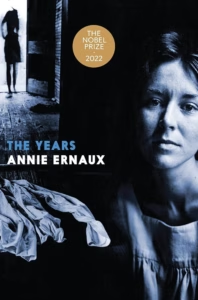 In The Years, Annie Ernaux steps back from the singular “I” and writes in “we.” She folds her own memories into the wider life of postwar France. Consumerism. Shifting gender roles. Class mobility. Advertising. Politics. The quiet revolutions that changed how people lived without ever appearing dramatic.
She refuses the idea that a woman’s story is only personal.
That refusal is one reason why memoir matters.
The Stories We Pretend Are Private Are Not Small
We have been trained to think that what happens in kitchens, bedrooms, grocery stores, classrooms, and small apartments is private. Meanwhile, what happens in parliaments and boardrooms is labeled public and historic.
But the kitchen is where money runs out. The bedroom is where power shows up. The grocery store is where inflation lands. The classroom is where opportunity divides.
Those spaces are not background. They are where history touches real bodies.
When Ernaux writes about women stretching every franc while trying to look composed, she is not writing nostalgia. She is documenting the cost of a patriarchal culture predominant in many cultures.
That system told men they must carry the financial weight of the family. It told women they must hold the emotional center. It told both of them that if something cracked, it was personal weakness.
Memoir exposes the lie.
This is why memoir matters.
A Sass Star Who Claimed the Record
Annie Ernaux is a Sass Star because she claimed space in the archive. Her work traveled far beyond France. It was translated widely and ultimately recognized with the Nobel Prize in Literature for her body of autobiographical writing.
She showed how class shapes aspiration. How mobility creates both pride and estrangement. How culture presses against ordinary people until they mistake structural tension for personal failure.
She did not write fairy tales about perfect providers or obedient families. She wrote the strain. The ambition. The contradiction between survival and selfhood.
That is why memoir matters. It makes the invisible visible.
When We Write, the Myth Gets Thinner
The idea that this is a man’s world survives because of selective storytelling. When public power is documented, and private labor is ignored, it looks as if one group built everything and another group simply inhabited it.
That picture is false.
Women have always been stabilizing families, stretching resources, absorbing cultural pressure, and negotiating roles that were never neutral.
When a mother works full-time and still feels she is failing at home, that is not a personal flaw. It is structural tension. When a daughter rises socially and feels both gratitude and loss, that is not ingratitude. It is the cost of mobility.
Memoir does not erase struggle. It names it clearly enough that shame loosens.
The more memoir includes all of us, the harder it becomes to maintain a fantasy version of history.
This is why memoir matters.
Your Story Is Not Decorative
If you have been waiting for permission to write because your life feels ordinary, consider this: culture is made of ordinary negotiations.
It is made of compromises. Of expectations. Of silent endurance. Of private reckonings.
When those accounts go unwritten, the record tilts.
When you write honestly about how class, gender, money, marriage, work, and expectation shaped you, you contribute clarity. You resist simplification. You replace myth with memory.
That is not indulgence.
That is contribution.
Find Your Story and Begin Your Memoir
If you are ready to move from thinking about writing to actually beginning, start with structure.
 Download Five Must-Dos to Find Your Story and Begin Your Memoir.
This guide will help you clarify what you are really writing about, avoid common memoir mistakes, anchor your story in purpose, and begin deliberately instead of circling.
Understanding why memoir matters is one thing.
Writing yours is another.
History is not finished.
It expands when we add to it.
What are you ready to say out loud?