
The Secret Power of Book Titles
Why Some Say “Buy Me” and Others Say “Nope, Not the One.”
Two Books, Two Title Dilemmas
When I finished my first book, I wanted to call it Why We Walk.
It fit. My son and I spent over a year walking through Wisconsin, asking what it means to belong to a place, to each other, to the living world.
But when I sent the manuscript out under that title, every publishing professional shook their heads at Why We Walk. Too quiet, they said. Too vague.
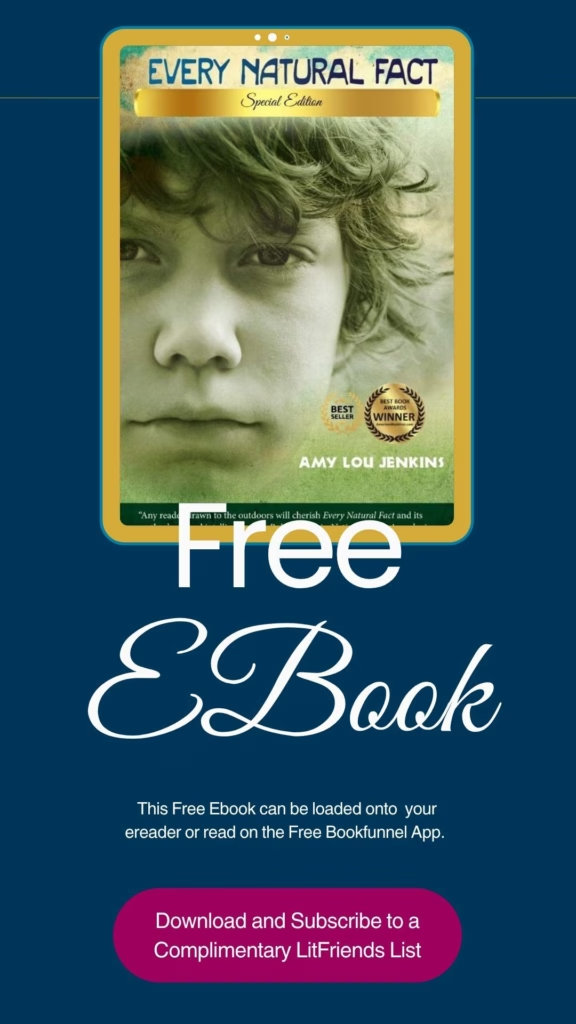
The book became Every Natural Fact—a name that sounded sturdy, literary, maybe even a little professorial. Definitely Emersonian. And it worked. The book found its readers. Still, I’ve never stopped loving Why We Walk. It’s a nod to the American walking essays, curious and unguarded.
Now, as I prepare to pitch and publish my new memoir, The Alchemy of Sass: A Revolution of Becoming and Belonging, I feel that same pull: my urge to name things boldly against the old pressures to stay agreeable and small. Alchemy speaks to transformation. Sass speaks to defiance. It risks being misunderstood—but that may be the point.
Writers spend years finding their voice, then just as long naming it. This isn’t just my issue.
Before They Were Classics: Can You Guess the Real Book?
Publishing history is full of almost-titles that would have changed how we read the stories entirely.
See if you can match these early drafts to the books we know today:
-
First Impressions →?
-
Trimalchio in West Egg →?
-
Monster →?
 (Answers below the free download box. Books are linked to Amazon. “As an Amazon Associate, I earn from qualifying purchases at no cost to you.)
↓ Grab your complimentary copy of Every Natural Fact and join LitFriends for essays, giveaways, and early access to The Alchemy of Sass: A Revolution of Becoming and Belonging. ↓
Answers
-
Pride and Prejudice by Jane Austen
-
The Great Gatsby by F. Scott Fitzgerald
-
Wild by Cheryl Strayed
It’s hard to imagine First Impressions on a tote bag or Trimalchio in West Egg topping bestseller lists. The right title doesn’t just label a story—it shapes who stops, who stays, and who falls in love.
What Book Title Psychology Teaches Us
Behind every unforgettable title is a blend of emotion, rhythm, and subtle brain science. Here are three key takeaways that explain why we reach for one book and pass by another.
1. We trust what’s easy to read.
Researchers call it processing fluency: when words flow, our brains interpret them as more truthful and appealing.
That’s one reason titles like The Silent Patient or Educated feel instantly trustworthy—they’re smooth, compact, and concrete.
(Source: Princeton University, “Processing Fluency and Aesthetic Pleasure.”)
2. A touch of mystery hooks us.
The best titles tease a question without answering it, creating a curiosity gap.
Think Gone Girl (Gillian Flynn) or The Midnight Library (Matt Haig). Each hints at what’s missing, not what’s there.
(Source: Loewenstein, “The Psychology of Curiosity,” Psychological Bulletin.)
3. Sound is memory’s secret weapon.
We remember titles that sing: cadence, alliteration, or contrast make them linger.
Say Eat Pray Love or The Night Circus aloud—the rhythm itself is satisfying.
Marketing studies indicate that alliterative phrasing can increase recall by nearly 40 percent.
(Source: Kessler & Dermer, Journal of Consumer Research.)
The Balancing Act: Clarity Meets Intrigue
Every strong title lives in the tension between clarity (what the reader grasps instantly) and intrigue (what they must open the book to discover).
-
Every Natural Fact leans toward clarity and credibility.
-
Why We Walk leans toward intimacy and wonder.
-
The Alchemy of Sass: A Revolution of Becoming and Belonging tries to marry both—transformation and rebellion in equal measure.
A good title, like a good sentence, leaves enough unsaid for the reader to lean in.
Fiction, Nonfiction, and the Genre Between
Fiction seduces through emotion and world-building; the title must invite immersion (Lessons in Chemistry, Where the Crawdads Sing).
Nonfiction promises value and clarity (Atomic Habits, Braiding Sweetgrass).
And memoir—the hybrid heart of both—offers transformation told as truth.
Memoir doesn’t sell expertise; it offers recognition. Titles like When Breath Becomes Air and This Boy’s Life promise experience, not instruction.
A memoir title should sound alive on the tongue and honest in the heart.
For Readers and Writers
If you’re a reader, notice what makes your hand stop on a crowded shelf—was it clarity or curiosity, warmth or edge?
If you’re a writer, test your title aloud:
-
Does it flow or snag?
-
Does it make a promise you can keep?
-
Would you pick it up if it weren’t yours?
A title is a mirror held up to both the story and its intended reader.
Your Turn
-
Would Why We Walk have drawn you in more—or less—than Every Natural Fact?
-
Do you think The Alchemy of Sass: A Revolution of Becoming and Belonging will keep its title once it meets the publishing world?