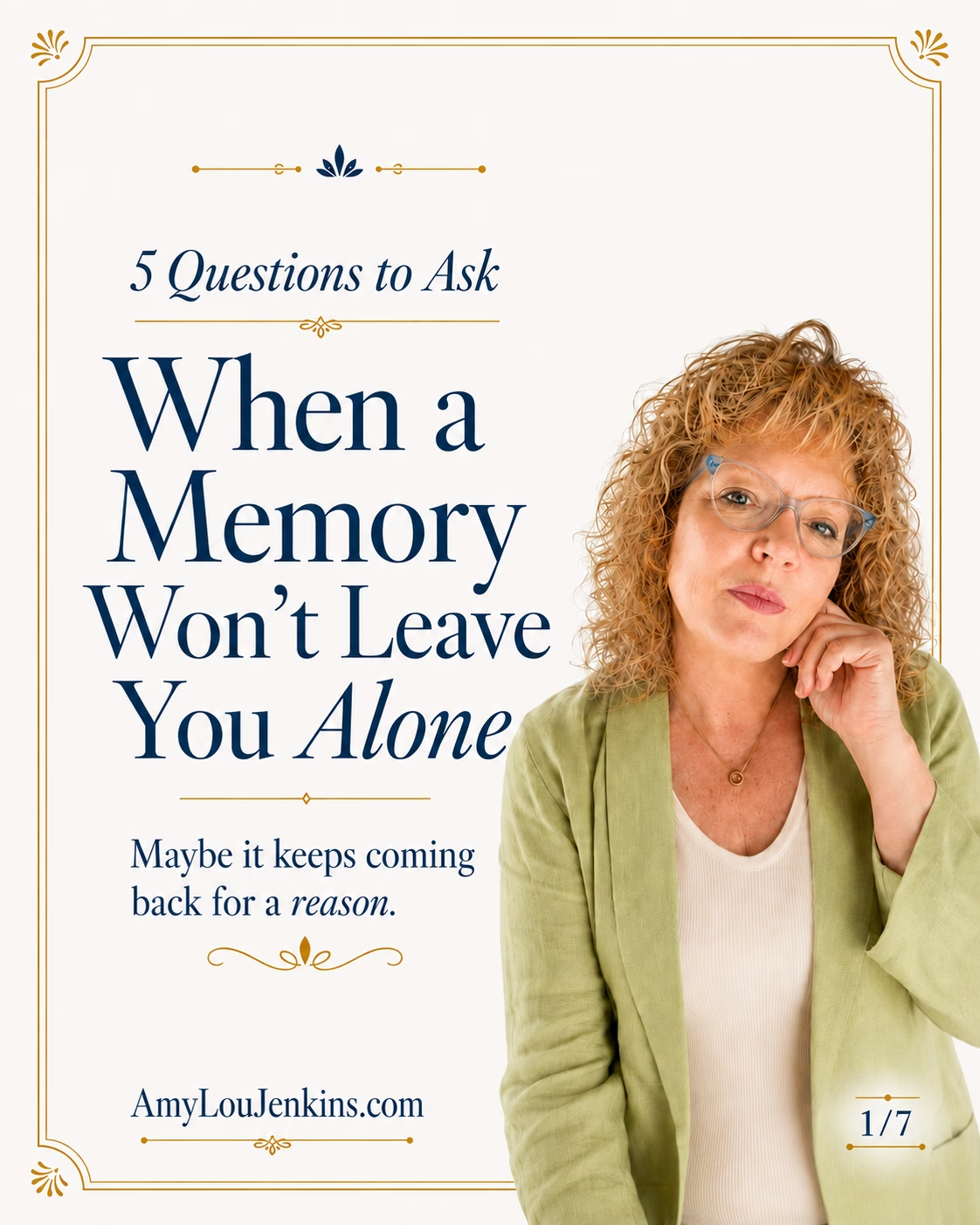
5 Memoir Writing Prompts for Recurring Memories
Mine Those Images and thougts: they are sources of unresoved and unrealized potential (A GOLD MINE)

Why certain memories return, how writing can cue more detail, and what memoirists need to know about memory gaps, meaning, and truth.
Some memories have terrible manners.
You can be making coffee, driving to the grocery store, or trying to sleep when a scene from twenty years ago walks in without knocking.
Maybe you remember your father's hand on a doorknob. The blue bowl on your grandmother's table. A sentence somebody said in a parking lot. You don't know why this moment survived while whole months of your life seem to have gone missing.
Pay attention.
A recurring memory does not arrive carrying a little card that says THIS IS IMPORTANT TO YOUR MEMOIR. Still, the memories that return can be worth following. Not because every persistent memory contains a revelation, but because memory and meaning are often tangled together.
Journaling gives you a way to pull at the knot.
These five memoir writing prompts move from memory to reflection to meaning. You don't need to be writing a book to use them. But if you are writing memoir or creative nonfiction, what you discover may lead you toward the story underneath the events.
1. Why this memory?
Start with the memory that keeps showing up.
Don't begin by asking whether it is dramatic enough for a book. Ask why this particular moment still has a hold on you.
Write the scene as you remember it. Then start questioning it:
What catches your attention first?
What part do you rush past?
Whose face can you see?
What sentence can you still hear?
What do you wish you understood?
Stay with the physical world. A remembered scene gains force from particulars, not from announcing its importance.
In my book Every Natural Fact, one porch scene contains a flying ant caught in my hair, a teenager speeding past in her new used car, Queen Anne's lace trembling along the road, and my son walking outside to tell me Michael will arrive at four. None of those details declares the meaning of the scene. They give the memory a world in which meaning can emerge.
That distinction matters. Memoir is not a summary of significant events. It is an inquiry conducted through story.
So journal about the memory before deciding what it proves.
Curiosity first. Verdict later.
2. What did I believe then?
One of the richest tensions in memoir exists between the person who lived the event and the person who is writing about it now.
Let both people onto the page.
First, write from inside the earlier self:
What did I believe about myself?
What did I believe about the other person?
What did I think love required?
What did I believe about family, safety, success, loyalty, God, money, marriage, ambition, belonging?
Resist the urge to hand your younger self the wisdom you acquired later. She didn't have it yet.
Tara Westover's Educated gains much of its force from this distance. The child and young woman who accepted her family's version of the world is not the same narrator who can later examine it. Westover has described repeatedly contacting family members while writing to ask about concrete details, down to machines and pieces of equipment. The book's inquiry is not only What happened? It is also How did I understand what was happening at the time?
That gap creates movement.
If the person at the beginning of a memoir understands the world exactly as the narrator does at the end, the book has nowhere to go.
When your old belief collides with what you know now, mark the spot.
There may be story there.
3. What do I understand differently now?
Now let the present-day writer enter.
Return to what you just wrote and ask:
What can I see now that I could not see then?
Perhaps you understand another person's motives differently.
Perhaps you understand your own.
Perhaps a family story you repeated for thirty years has begun to wobble.
Good. Let it wobble.
Memoir doesn't require you to begin with the answer. In fact, arriving with every conclusion nailed down can flatten the work. The writing gets more interesting when the writer is trying to discover what she thinks.
Kiese Laymon's Heavy provides one model. Laymon writes about his mother, his body, addiction, violence, race, love, secrecy, and his own failures without arranging himself into the role of innocent observer. He described the project as a reckoning rather than a tell-all. The distinction matters: a reckoning asks the writer to examine the self as vigorously as everyone else on the page.
Try this with your recurring memory:
The story I used to tell myself about this was...
Then:
What I can see now is...
Don't force the two answers to agree.
Their disagreement may be the engine.
4. What feeling is still unfinished?
Anger. Grief. Shame. Pride. Longing. Relief. Envy.
Sometimes an event is over and the feeling has nowhere to go.
Try beginning a page with:
What I never got to say was...
Then don't tidy yourself up.
You aren't submitting this page to the Nobel committee. You are finding out what is there.
The first answer may be accusation. Keep writing.
The second may be self-defense. Keep writing.
By page three, you may discover that the thing underneath your anger is grief, or the thing underneath grief is relief, which can be inconvenient. Art has never shown much respect for convenience.
Carmen Maria Machado built In the Dream House from an experience that resisted easy resolution. Rather than forcing her abusive relationship into one smooth chronological account, she approached it through fragments and shifting forms. Machado has said that writing the memoir did not produce a neat therapeutic resolution. The form became a way of examining an experience she was still trying to understand.
That offers memoir writers useful permission:
You do not have to understand a memory before you begin writing about it.
The page can be where you investigate.
If one journaling session doesn't get you to the root, return tomorrow. Then next month.
Maybe the material is thin.
Maybe you haven't dug far enough.
Maybe there's a book there.
5. Why might this memory matter now?
This question changes the direction of the inquiry.
You aren't remembering the event from nowhere. You are remembering it from this version of yourself, at this point in your life.
Why now?
What has changed?
What question are you asking today that you couldn't ask at twenty-five?
What does this old memory have to say about the life you are living now?
Autobiographical memory works through networks of association. A picture, odor, name, object, place, or other cue can help bring a personal event back into reach, and autobiographical recollection recruits brain systems involved in reconstructing experiences from pieces of perceptual and conceptual information. Researchers distinguish between memories that seem to arrive at once and memories reached through a more deliberate search process using other knowledge as cues.
Which brings us to a fear I hear from memoir writers all the time.
Can I write a memoir if I don't remember everything?
Yes.
You don't need a complete recording of your past. Nobody has one.
And don't assume that what you can recall during your first fifteen minutes with a blank page is the full inventory.
Writing one detail can cue another.
You remember the kitchen. Then the linoleum.
The linoleum reminds you of lying on the floor.
That reminds you of the dog.
The dog reminds you that it was summer because he had just been shaved.
Now you remember the fan in the window.
Memory researchers have found that retrieval cues can help people access information that was not immediately available, and self-generated cues can aid recall.
So when a scene feels bare, try giving your memory more doors:
Look at photographs.
Draw the floor plan.
Find the address on a map.
Listen to music you played then.
Handle an object from that period.
Check old calendars, letters, journals, emails, texts, school records, recipes, medical records, weather reports, or newspaper archives when relevant.
Ask someone else what they remember.
Then draft again.
More may come.
But here's the catch.
Remembering more is not the same as remembering more accurately.
Memory is not a surveillance camera
Autobiographical memory is reconstructive. When we remember, the brain does not pull an untouched recording from storage. It assembles an experience from different kinds of information. Research also shows that even memories that feel repetitive can change across retrievals.
For memoirists, that is not a reason to give up.
It is a reason to get serious about the difference between memory, interpretation, and verifiable fact.
David Carr pushed that distinction to an extreme in The Night of the Gun. Writing about years clouded by addiction, he didn't trust his memory to carry the whole load. He conducted sixty videotaped interviews and used legal and medical records during three years of reporting to investigate his own past.
You don't have to turn your memoir into a criminal investigation.
But if a material fact can be checked, check it.
Was it 1987 or 1989?
Was the restaurant really there yet?
What did the medical record say?
Who owned the house?
Did that storm happen on that date?
If another person remembers an event differently, that difference does not automatically make either of you a liar. It may belong in the story.
You can write:
I remember...
My sister remembers...
The record says...
I can't know...
Those sentences do not weaken a memoir. Used with care, they establish the terms of your inquiry.
Your memory may be fallible.
So is everyone else's.
And still, your experience of your life is yours to examine and write. You do not need family consensus before you are permitted to put words on paper. You do owe the reader good faith: investigate what can be investigated, distinguish uncertainty from fact, and don't manufacture certainty because certainty makes a prettier paragraph.
Follow the memory that keeps knocking
The memory that returns may turn out to be nothing more than an old scene with excellent persistence.
Or it may contain a question you have not finished asking.
Start there.
Why this memory?
What did I believe then?
What do I understand differently now?
What feels unfinished?
Why does this matter to me now?
Don't demand a book from the first page.
Journal toward the meaning.
See what opens.
And if the writing keeps opening doors, follow it.