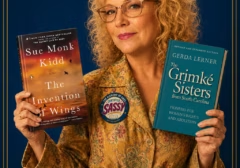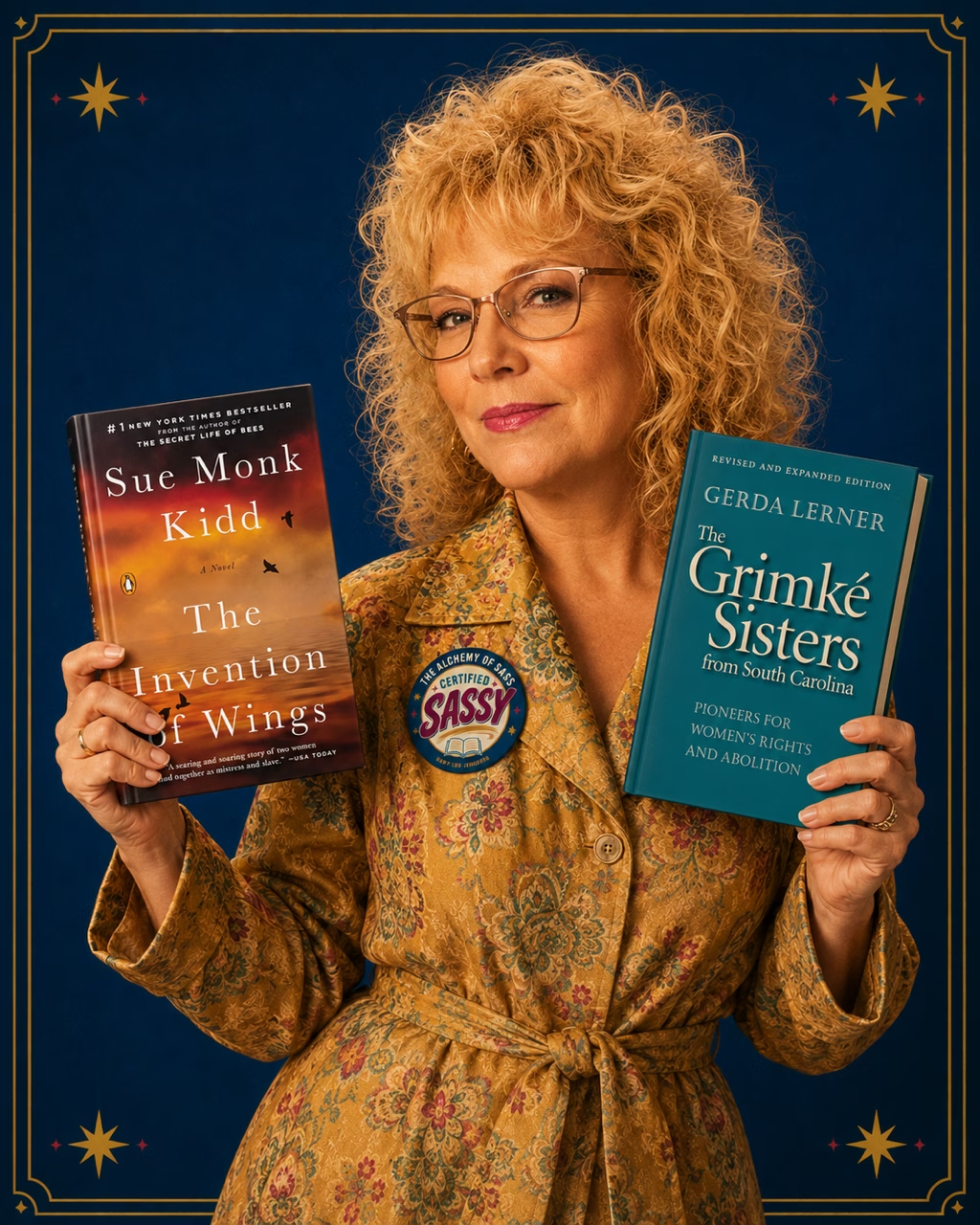
Grimké Sisters: Gerda Lerner and Sue Monk Kidd
What The Grimké Sisters from South Carolina and The Invention of Wings teach us about nonfiction, historical fiction, moral courage, and the values we inherit.
Gerda Lerner’s The Grimké Sisters from South Carolina introduced me to two girls born into the wealth slavery created who grew up to reject the system that enriched their family.
Their choices left me with a question I have kept asking ever since:
Why can some people question the programming they inherit, weigh conscience against comfort and belonging, and choose differently, while others defend the system that formed them?
Sarah Grimké was born in 1792 and her younger sister Angelina in 1805, into a wealthy Charleston family that enslaved people. The family’s money, household labor, and social position depended in part on a system that treated human beings as property. Yet both girls recoiled from the slavery and cruelty surrounding them.
 Explore The Grimké Sisters from South Carolina: Pioneers for Women's Rights and Abolition at Your Favorite Bookseller
Lerner gives us Sarah as a child going to the wharf, hoping to find passage to a place without slavery. In another scene that stayed with me, one of the sisters objects to an enslaved person fanning someone else in the Southern heat. Wasn’t she hot, too?
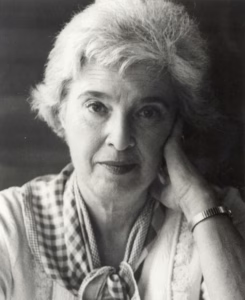
Gerda Lerner 1981ults had religious, economic, and social justifications for slavery. Sarah and Angelina kept recognizing the humanity those explanations required them to ignore.
Surely they were not the only white children in the slave
holding South who witnessed cruelty and knew that something was wrong. Others must have recoiled. Many eventually accepted the explanations adults supplied. Some benefited from slavery. Some defended it.
Sarah and Angelina kept questioning. I wanted to understand why.
When Conscience Begins as Sass
As a child, I was told not to give any sass when I questioned unfairness. But talking back is not necessarily defiance. Often, it is conscience learning to speak.
I noticed contradictions. Adults taught kindness, honesty, fairness, and love, then behaved in ways that violated those values. I asked why. I was often expected to swallow the question.
The injustices I questioned as a child bear no comparison to slavery. What I recognized in Sarah and Angelina was the impulse to question a rule when the rule violated the values adults claimed to honor.
Their choices made me ask harder questions. Why does one person act on what she recognizes as wrong while another learns to accommodate it? What makes someone risk family approval, status, money, safety, or belonging rather than violate a deeply held value?
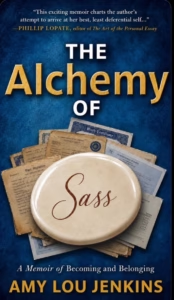
I kept asking those questions while writing my forthcoming memoir, The Alchemy of Sass: A Memoir of Becoming and Belonging. The book examines the lies, secrets, and assumptions I inherited and the long process of deciding which values deserved my loyalty.
The Grimké sisters did more than decide slavery was wrong. They changed how they lived. That difference between recognizing a value and acting on it may be what fascinates me most.
Gerda Lerner and Sue Monk Kidd helped me understand what those choices required.
Gerda Lerner Documents the Choices the Grimké Sisters Made
Gerda Lerner chose to spend years studying two women who had received far less historical attention than their importance warranted.
She researched Sarah and Angelina Grimké, made their lives the subject of her doctoral dissertation at Columbia University, earned her Ph.D. in 1966, and published The Grimké Sisters from South Carolina the following year. Lerner later became one of the scholars who established women’s history as an academic field. In 1980, she joined the University of Wisconsin-Madison and founded its Program in Women’s History.
Those choices matter. Archives contain letters, speeches, legal papers, diaries, newspaper accounts, church records, and government documents. They do not decide which people deserve study. Historians do.
Lerner decided that Sarah and Angelina Grimké deserved sustained attention, and she built her argument from evidence.
A nonfiction biographer works under constraints that give the form much of its authority. Lerner can interpret Sarah’s letters, trace Angelina’s speeches, examine their religious conflicts, follow their abolitionist work, and place both women within the movements for abolition and women’s rights.
She cannot create an event because the narrative needs one. She cannot assign a motive because it would make Sarah easier to admire. Because Lerner must support her claims with evidence, readers can distinguish what the documents establish from what remains uncertain.
That matters when we ask why the sisters acted differently from so many people around them.
Lerner documents two women born into a family that benefited from slavery who became abolitionists, writers, lecturers, and advocates for women’s rights. Their public opposition to slavery exposed another contradiction.
Women were expected to remain outside political debate. Sarah and Angelina were criticized not only for what they said about slavery, but for speaking publicly at all. Their abolitionist work forced them to confront rules that restricted women’s speech and authority.
Questioning one injustice required them to examine another.
And the opening question becomes more difficult. Sarah and Angelina were not choosing between good and evil in the abstract. They were weighing conscience against family loyalty, religious authority, financial security, social standing, and belonging.
Lerner can document those choices. But documents cannot tell us everything about what it felt like to make them.
Sue Monk Kidd Imagines What the Documents Cannot Tell Us
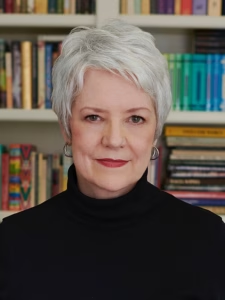
Sue Monk Kidd encountered the Grimké sisters much later and approached Sarah as a novelist rather than a historian. That distinction changes what she can do.
In The Invention of Wings, Kidd begins with eleven-year-old Sarah receiving an enslaved girl, Hetty “Handful” Grimké, as a birthday present. Handful is Kidd’s fictional creation. Kidd researched the Grimké family, Sarah and Angelina’s writings, nineteenth-century Charleston, slavery, laws, clothing, architecture, religious practices, household customs, and other details before constructing the novel.
Then she creates what the documents cannot provide. She writes dialogue. She imagines private conversations. She follows fear, resentment, desire, doubt, affection, ambition, compromise, and resistance.
The nonfiction writer is accountable to the record. The historical novelist is accountable to the record and responsible for distinguishing documented fact from invention.
Lerner establishes what the evidence supports. Kidd constructs an imagined experience of living inside those conditions.
Lerner can document what Sarah wrote, where she traveled, what she argued, and how other people responded. Kidd can ask what it might have felt like to be eleven years old and told that another child belonged to you.
She can also shift the reader’s attention from Sarah to Handful. That decision changes what the reader must confront.
Handful is fictional, but slavery controlled the labor, movement, family relationships, bodies, and futures of real enslaved women and girls. Kidd gives Handful narrative authority rather than limiting the novel to Sarah’s moral awakening.
The reader therefore confronts two radically unequal experiences of the same household. Sarah struggles against a system that benefits her. Handful must survive a system that owns her.

Reading the novel does not tell us what Handful, or any specific enslaved woman, actually thought. It asks us to consider the human consequences of facts a historian can document.
How Reading Lerner and Kidd Together Deepens Understanding
Reading Lerner and Kidd together combines documented evidence with imagined interior experience. The biography and the novel do not compete. They operate under different rules.
A novel cannot become historical evidence simply because the novelist researched carefully. A biographer cannot invent undocumented conversations simply because they would make the narrative more vivid. Reading both makes those boundaries clear.
It also complicates the opening question.
Sarah and Angelina did not merely discover that slavery was wrong and proceed neatly toward courage. Their choices involved family loyalty, faith, money, reputation, safety, gender expectations, and belonging.
A person can love family members and reject what those family members believe. A person can benefit from an institution and decide that personal benefit does not make the institution just. Religious teaching can conflict with religious institutions. Belonging can require silence. Financial security can reward compliance.
Moral courage requires a person to sort through those competing demands and decide which values will govern her actions.
Lerner documents the consequences of those decisions. Kidd asks readers to consider what the decisions might have felt like before anyone knew how the lives would turn out.
That is where paired reading becomes especially valuable. One writer gives us evidence. The other makes us spend time with the conflicts that evidence cannot fully describe.
Reading Literature Expands Our Ability to Understand Human Choice
Reading literature expands our ability to understand how people act when family loyalty, money, faith, love, safety, and conscience pull them toward different choices.
Great books return to these conflicts again and again. Jane Eyre must decide what she will surrender for love and security and what she refuses to surrender even when leaving costs her dearly. John Steinbeck repeatedly writes about working people trying to feed families, secure homes, preserve dignity, and receive a fair return for their labor.
The circumstances differ, but the choice remains familiar: What does a person do when important values demand different actions?
Literature does not automatically make us better people. A person can read great books and remain selfish, dishonest, or cruel. We can also choose books that reinforce everything we already believe.
But serious reading can challenge our habit of seeking only ideas that confirm what we already think. A writer can require us to spend hours with people whose beliefs, circumstances, fears, or choices differ from our own.
We follow decisions to consequences. We encounter motives we might otherwise dismiss. We learn that courage can coexist with fear, love with anger, loyalty with dissent, and good intentions with terrible consequences.
Reading does not guarantee moral courage. It can increase our understanding of what moral courage demands.
And that returns me to Sarah and Angelina. Knowing that slavery was wrong was not enough. They had to decide what they were willing to lose because they believed it was wrong.
What Do We Do When Our Values Cost Us?
Sarah and Angelina Grimké did not condemn an injustice from which their family stood safely apart. Their family benefited from slavery.
Rejecting it threatened relationships, status, religious belonging, financial security, and assumptions they had been taught since childhood.
That is the harder test of a value. It is easy to announce a principle when the principle costs us nothing. The test comes when acting on it risks approval, comfort, money, status, belonging, or safety.
Gerda Lerner documents two women who accepted those risks. Sue Monk Kidd uses historical fiction to examine the people, relationships, fears, and consequences surrounding such choices.
Reading both books made me ask questions I was not finished asking when I closed them.
Which values have I inherited without examining them? Which values have I chosen? What am I willing to risk to live according to them?
I have kept asking those questions since I first encountered Sarah and Angelina in my thirties. I have asked them in my writing, my teaching, and eventually in The Alchemy of Sass.
They also changed what I understood sass to mean.
At its best, sass is not obstinacy for its own sake. It is remembering our values under pressure, recognizing when inherited rules violate them, and finding the courage to speak and act accordingly.