What Is Narrative Nonfiction?
Definition, Examples & Literary Techniques
Narrative nonfiction tells a true story using literary craft. Story is central to the form.
The writer decides where the story begins, which events and details belong, how scenes unfold, when information is revealed, how time moves, and what questions or tensions pull the reader forward. Scene, dialogue, characterization, setting, imagery, suspense, point of view, pacing, reflection, and structure all help shape factual material into story.
In nonfiction, we do not invent people, places, events, or evidence and present them as fact. When the record is incomplete, we can infer, interpret, wonder, and suppose, provided the language signals when we have moved beyond what can be documented.
That becomes especially important when we write from memory, reconstruct incomplete histories, or tell stories about people who left few records. Research, memory, interpretation, and story often meet at the gaps.
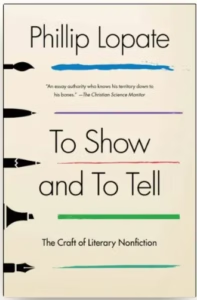 Explore To Show and to Tell at Your Favorite Bookseller
What Is the Difference Between Narrative Nonfiction, Creative Nonfiction, and Literary Nonfiction?
The borders among narrative nonfiction, creative nonfiction, and literary nonfiction are not fixed. Writers, teachers, publishers, editors, and universities use the terms differently, and one book may fit all three.
Lee Gutkind has long used creative nonfiction as a broad term for factual writing shaped with literary craft, including memoir, personal essay, biography, narrative history, and long-form reportage. He describes creative nonfiction as “true stories well told.” Creative refers to how the writer makes the work, not to invented facts.
Phillip Lopate uses literary nonfiction, including in the title of his craft book To Show and To Tell: The Craft of Literary Nonfiction. The term emphasizes nonfiction written as literature, with attention to language, structure, voice, characterization, reflection, and form.
I use narrative nonfiction when story provides much of the structure. Events unfold. Questions develop. People make choices. Discoveries change what the reader understands. One part of the story creates momentum toward the next.
The terms overlap. Looking at how the writer shapes true material, and how story functions in the work, tells us more than forcing every book into a single category.
What Kinds of Writing Are Included in Narrative Nonfiction?
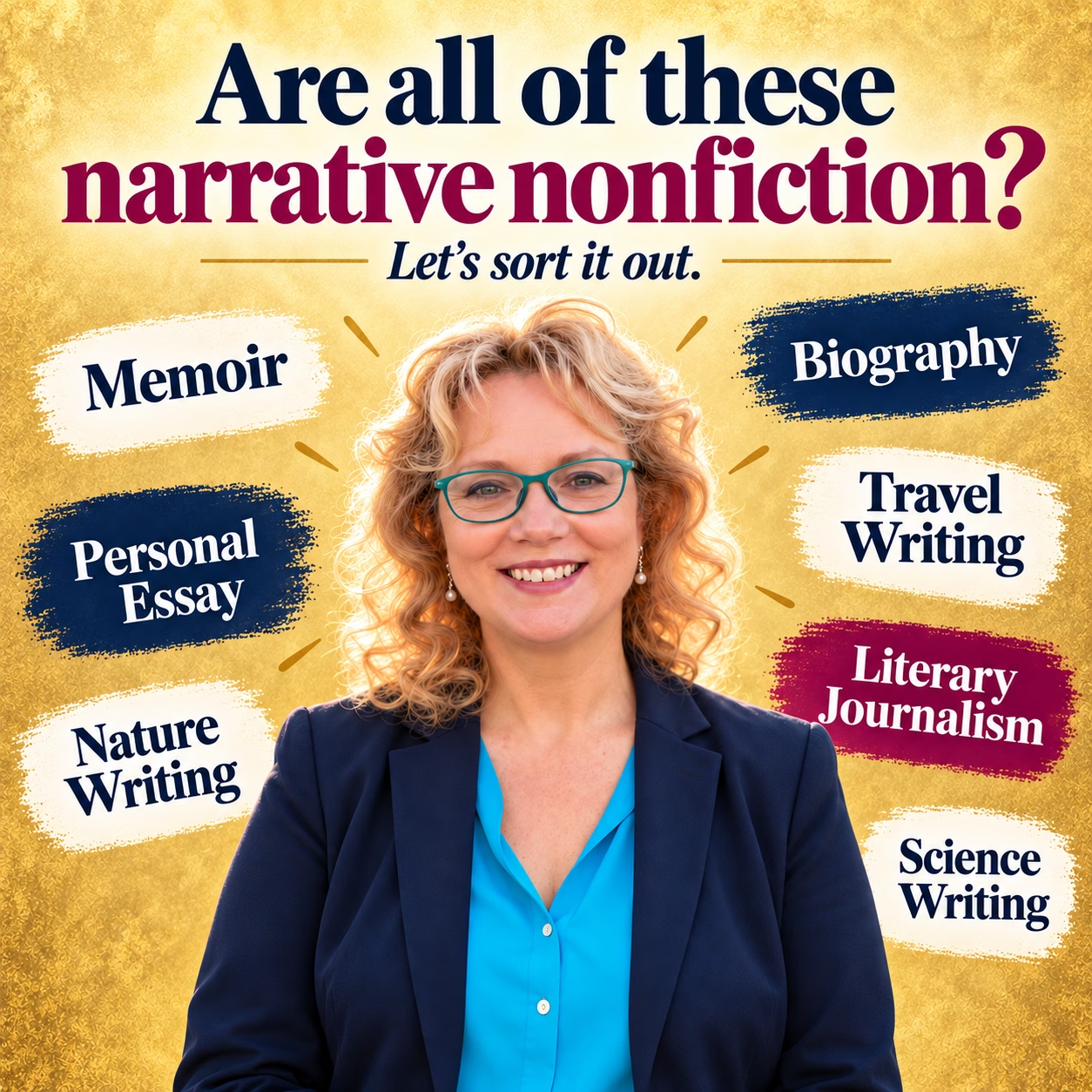
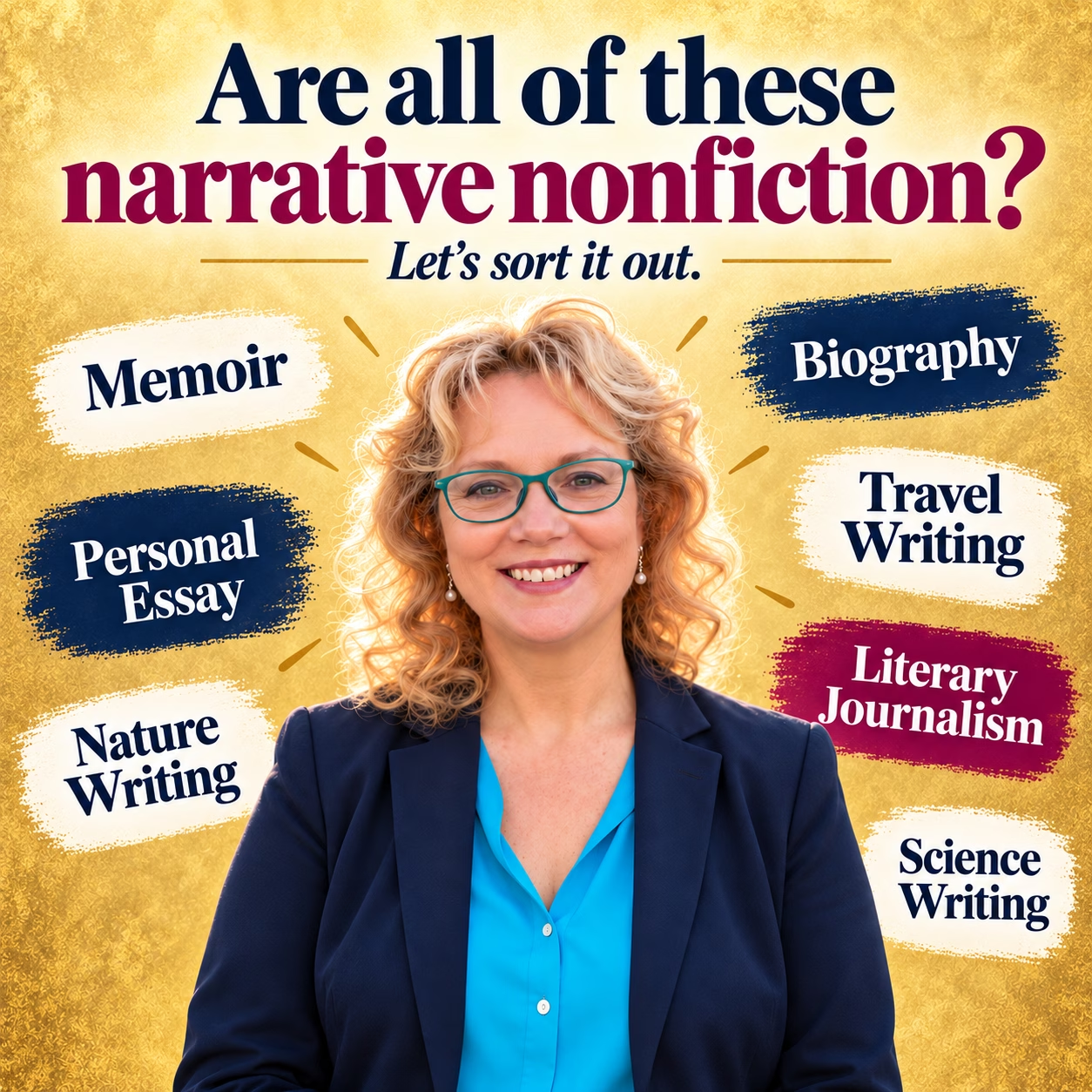
Memoir is one form of narrative nonfiction, but the category extends far beyond memoir. Biography, autobiography, literary journalism, narrative history, true crime, travel writing, nature and environmental writing, science and medical writing, immersion journalism, family history, cultural reporting, and personal essay can all use narrative.
The subject does not determine the form. A book about birds might organize its material around species, habitat, and identification. Another might follow a migration, an endangered population, a scientist’s investigation, or a writer searching for answers about the natural world. Both are nonfiction, but story provides much of the structure in the second.
What Literary Techniques Can Narrative Nonfiction Writers Use?
All of them. A technique belongs when it serves the story.
Scene, dialogue, characterization, setting, narrative voice, point of view, pacing, chronology, suspense, reflection, metaphor, imagery, symbolism, irony, foreshadowing, juxtaposition, repetition, motif, allusion, analogy, personification, fragmented structure, experimental forms, and hybrid forms can all belong in narrative nonfiction.
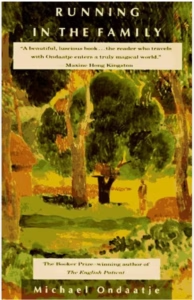 Explore Running in the Family at Your Favorite Bookseller
```Michael Ondaatje’s Running in the Family, for example, includes poetry and photographs alongside prose. The mixture suits a book concerned with family, memory, place, and the difficulty of reconstructing a past.
A passage of poetry might deepen one book and derail another. Disrupted chronology might illuminate a memoir about memory and confuse a straightforward account of an expedition. No literary device is prohibited simply because we associate it with poetry, fiction, drama, or another form. Writers choose the techniques that fit the story, the narrator, and the experience they want to create for the reader.
The factual record sets a separate boundary. A writer can foreshadow an event without inventing what happens later, use an object symbolically without claiming the people in the story understood it that way, reconstruct a scene from evidence, or suppose what might have happened while signaling the supposition.
The story determines which techniques belong; the factual record determines what the writer can claim as true.
What Is the Contract With the Reader in Narrative Nonfiction?
The opening of a work of narrative nonfiction begins making promises before the writer ever explains them. It tells us who is speaking, what story we have entered, how close the narrator stands to the events, and what kind of truth the book intends to pursue.
Because the work identifies itself as nonfiction, readers expect the writer to distinguish what can be established from what is remembered, inferred, disputed, or supposed.
Memory deserves particular caution. Memoir begins with memory, but memory is not proof. A responsible memoirist checks what she remembers against whatever else can be found: letters, photographs, calendars, newspaper accounts, medical records, public documents, other people’s memories, even the release date of a song.
You might remember singing a particular song at your ninth birthday party with complete confidence, then discover that the song was not released until the following year. The memory may preserve the pool, the singing, the feeling, even the people who were there while getting the year wrong.
Research can reveal where memory is accurate, where it has shifted, and where the discrepancy itself belongs in the story.
Other forms of narrative nonfiction bring different evidence. Journalism may rely on interviews, observation, documents, recordings, and reporting. History may draw from archives, letters, photographs, court records, newspapers, and material evidence. Family history may combine all of those with stories passed from one generation to another.
The narrator does not need perfect knowledge. Readers need to understand the basis of the story being told, including its gaps.
Conflicting accounts can remain conflicting. An inference can connect several facts without becoming a fact itself. Supposing can explore what might have happened without claiming that it did.
The opening also asks readers to invest in particular people, questions, tensions, or mysteries. A book may complicate those questions as it develops, but readers reasonably expect the story to honor the promises that first drew them in.
A trustworthy narrator tells us enough to understand what she knows, how she knows it, and when she has reached the edge of what can be known.
Can Narrative Nonfiction Use Reconstructed Dialogue?
Yes. Dialogue can reveal character, expose conflict, establish relationships, and turn remembered events into scenes.
Human memory is not a recording device. Few memoirists can reproduce a conversation from twenty or forty years ago word for word unless a recording, transcript, letter, diary, or other record survives.
We can still write remembered dialogue. We need to understand what memory can support and, when appropriate, tell readers how we handled reconstruction.
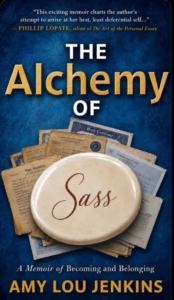 Explore The Alchemy of Sass: A Memoir of Becoming and Belonging at Your Favorite Bookseller
In my memoir, The Alchemy of Sass, I include conversations I remember from my life. I do not have transcripts, so at the beginning of the book I tell readers that dialogue is presented to the best of my recollection.
Reconstructing remembered dialogue as faithfully as possible differs from inventing a sharper line because the scene would work better with one. Reconstruction works from memory and evidence. Invention changes the story.
Can Narrative Nonfiction Writers Suppose or Imagine What They Cannot Know?
Yes. Missing evidence often convinces writers they no longer have the right to tell a story.
Research has limits. Letters disappear, records end, and people die before we can ask them questions. We may know where someone lived, what work she did, whom she loved, or what happened to her without knowing exactly what she thought or felt at a particular moment.
Research as fully as possible. When the evidence can take us no farther, we can analyze, interpret, wonder, infer, and suppose. The language needs to signal the change in certainty.
Perhaps.
I imagine.
She may have.
I wonder whether.
It seems possible.
Each tells the reader that we have moved from documented fact to possibility. The signal can be subtle. We do not need to stop and defend every supposition.
Supposing is not the same as pretending. Supposing begins with what we know and asks what those facts might reasonably suggest.
Essayist Lisa Knopp calls this practice “perhapsing.” Words and phrases such as perhaps, maybe, suppose, might have, could have, imagine, and wonder let a writer consider possibilities when the record ends without presenting conjecture as fact. Knopp also makes an important point about trust: telling readers what we do not know can make a narrator more reliable.
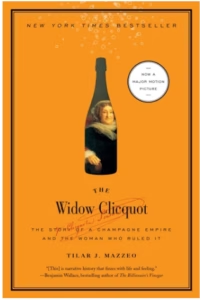 Explore The Widow Clicquot: The Story of a Champagne Empire and the Woman Who Ruled It at Your Favorite Bookseller
```Tilar J. Mazzeo uses this technique throughout The Widow Clicquot, her biography of Barbe-Nicole Clicquot Ponsardin. Much of Clicquot’s personal record has been lost. Mazzeo works from surviving evidence and the history surrounding Clicquot, then signals what was likely, possible, or imaginable.
Those signals increased my confidence in Mazzeo as a narrator. She showed me where the facts ended, so I trusted her when she asked me to consider what those facts might mean.
I also admire Clicquot herself. French law sharply restricted the legal and financial independence of married women, but widowhood created a loophole. Clicquot used it to take control of the business and build a champagne empire. As the author of The Alchemy of Sass, I recognize the sass in a woman who saw the narrow opening her culture left her and used it to claim authority, build a business, and create something enduring.
I have also watched supposing change what a writer believed she had the right to write. A woman in one of my classes was researching a great-aunt who had spent years in an asylum and died there. She had letters and historical records. The early letters showed little of the deterioration that became visible later. Her research also revealed that her great-aunt had sung in a choral group and worked with quilts.
My student could never know everything her aunt thought or felt during those years. She could, however, look at quilts from that world and write, I can imagine my great-aunt doing this work, trying to build a life of dignity.
She could also say that writing about her aunt and remembering her had become an act of restoring some of that dignity. Neither statement claims to be historical fact. Both connect evidence, interpretation, and point of view.
Narrative nonfiction can contain fact, memory, inference, interpretation, and supposing. A trustworthy writer lets readers know which is which.
Can a Narrative Nonfiction Writer Have a Point of View?
Yes. Every nonfiction writer decides what to investigate, which facts to include, which contradictions deserve attention, where to begin the story, whose accounts to examine, and which questions to pursue. Those choices create a point of view.
A writer can analyze evidence, challenge an accepted interpretation, or explain what she believes the evidence suggests. Interpretation becomes misleading when the writer presents it as established fact.
A narrator does not become more trustworthy by disappearing. Readers need enough information about the evidence and reasoning to judge the story and its conclusions for themselves.
Does Narrative Nonfiction Have to Be Written in First Person?
No. First person works well when the writer participates in the story, investigates a question, or guides the reader through a developing understanding, but narrative nonfiction does not require an I.
A journalist can reconstruct another person’s life. A historian can build a story from archives. A science writer can follow researchers, patients, discoveries, or ideas. A biographer can tell the story of someone who died centuries earlier.
Point of view matters more than pronoun choice. Readers need to understand who is telling the story, how the narrator knows what she knows, what evidence supports the account, and where certainty ends.
Is Memoir Narrative Nonfiction?
Yes. Memoir is one form of narrative nonfiction, but narrative nonfiction is not another name for memoir.
The 2026 Kirkus Prize nonfiction finalists offer a useful sample of the range. Ada Ferrer’s Keeper of My Kin: Memoir of an Immigrant Daughter combines memoir, family history, migration, and a historian’s perspective. Loubna Mrie’s Defiance: A Memoir of Awakening, Rebellion, and Survival in Syria places an individual life within political upheaval. Gisèle Pelicot’s A Hymn to Life: Shame Has To Change Sides, written with Judith Perrignon, tells the story from the perspective of the woman who lived its central events.
 Explore A World Appears: A Journey into Consciousness at Your Favorite Bookseller Barnes & Noble
```Other finalists enter their stories as reporters, researchers, or investigators. Pamela Colloff’s Catch the Devil: A True Story of Murder, Deception, and Injustice on the Gulf Coast investigates a criminal justice story through reporting and evidence. Patrick Radden Keefe’s London Falling: A Mysterious Death in a Gilded City and a Family’s Search for Truth investigates a death and a family’s search for answers. Michael Pollan’s A World Appears: A Journey Into Consciousness explores consciousness through science, reporting, interviews, ideas, and personal experience.
The writer may be memoirist, historian, reporter, investigator, participant, or guide. Story can organize factual material in each approach.
How Is Narrative Nonfiction Different From Informational Nonfiction?
Much nonfiction organizes material primarily around information. Textbooks, reference works, traditional how-to books, and explanatory articles may proceed through definitions, categories, principles, evidence, instructions, or arguments.
Narrative nonfiction organizes factual material through story. A person searches, remembers, investigates, survives, discovers, changes, tries to understand, or encounters obstacles. Questions develop. New information alters understanding. Events have consequences.
The forms overlap. Narrative nonfiction can contain substantial history, science, cultural criticism, or explanation, just as informational nonfiction can contain anecdotes and scenes. In narrative nonfiction, story carries a significant share of the structure.
How Is Narrative Nonfiction Different From Historical Fiction?
Historical fiction and narrative nonfiction can use the same literary techniques: scene, character, setting, dialogue, suspense, imagery, and detailed description.
Historical fiction can invent conversations, private thoughts, characters, incidents, and scenes for which no evidence exists. Invention is part of the form.
Narrative nonfiction begins with evidence. The writer can reconstruct, infer, interpret, and suppose when the prose makes clear what is known and what has been concluded or imagined from the evidence.
The factual record sets the boundary. Within it, the writer has enormous room for art.
Can Narrative Nonfiction Be Creative Without Making Things Up?
Yes. Creativity in nonfiction does not depend on fabrication.
It appears in structure, voice, selection, juxtaposition, language, pacing, research, scene, characterization, reflection, metaphor, and the connections a writer discovers among facts. Two writers can begin with the same factual material and produce radically different books because each will make different choices about the story.
Research itself can become creative work. A writer may recognize a pattern no one has named, place two facts beside each other and see a connection, question an inherited explanation, or follow one piece of evidence until it changes her understanding of the larger story.
The facts remain factual. The writer creates the story from them.
Why Narrative Nonfiction Matters
Narrative nonfiction matters because story makes meaning. It can turn factual material into an experience for the reader.
John Hersey’s Hiroshima followed six survivors of the atomic bombing. Americans already knew Hiroshima had been destroyed. Hersey gave readers the people inside that history: what they saw, what happened to their bodies and families, how they survived, and what followed.
In The Warmth of Other Suns, Isabel Wilkerson tells the history of the Great Migration through three people who left the South. The migration involved roughly six million Black Americans. Wilkerson gives that enormous movement individual lives, choices, risks, losses, and consequences.
Rebecca Skloot’s The Immortal Life of Henrietta Lacks connects the history of HeLa cells and medical research to Henrietta Lacks and her family. Through their story, questions about race, informed consent, ownership, medical ethics, and scientific progress become personal as well as scientific.
Narrative nonfiction can make history immediate, science comprehensible, and lives far removed from our own matter to us. Readers do not only learn what happened. Story lets them experience events through the people who lived them.
Narrative nonfiction offers truth, empathy, investment in other lives, broader understanding, and a fuller sense of the complexity of history and life.
It is also literature. Language, image, rhythm, scene, suspense, structure, reflection, humor, and voice can make factual material beautiful and absorbing.
Books such as Hiroshima, The Warmth of Other Suns, and The Immortal Life of Henrietta Lacks have affected culture because their stories gave facts human consequence. A reader may forget a statistic and remember a person. That person can change how the reader understands a war, a migration, a scientific discovery, or a history she thought she already knew.
And narrative nonfiction can do all of that beautifully.