Medical Memoir
Michael Caprio Writes About the Process of Survival
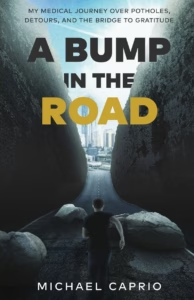
The author of A Bump in the Road on what illness did to his body, his family, and his understanding of himself — and why the chapter he was most ashamed of became readers' favorite.
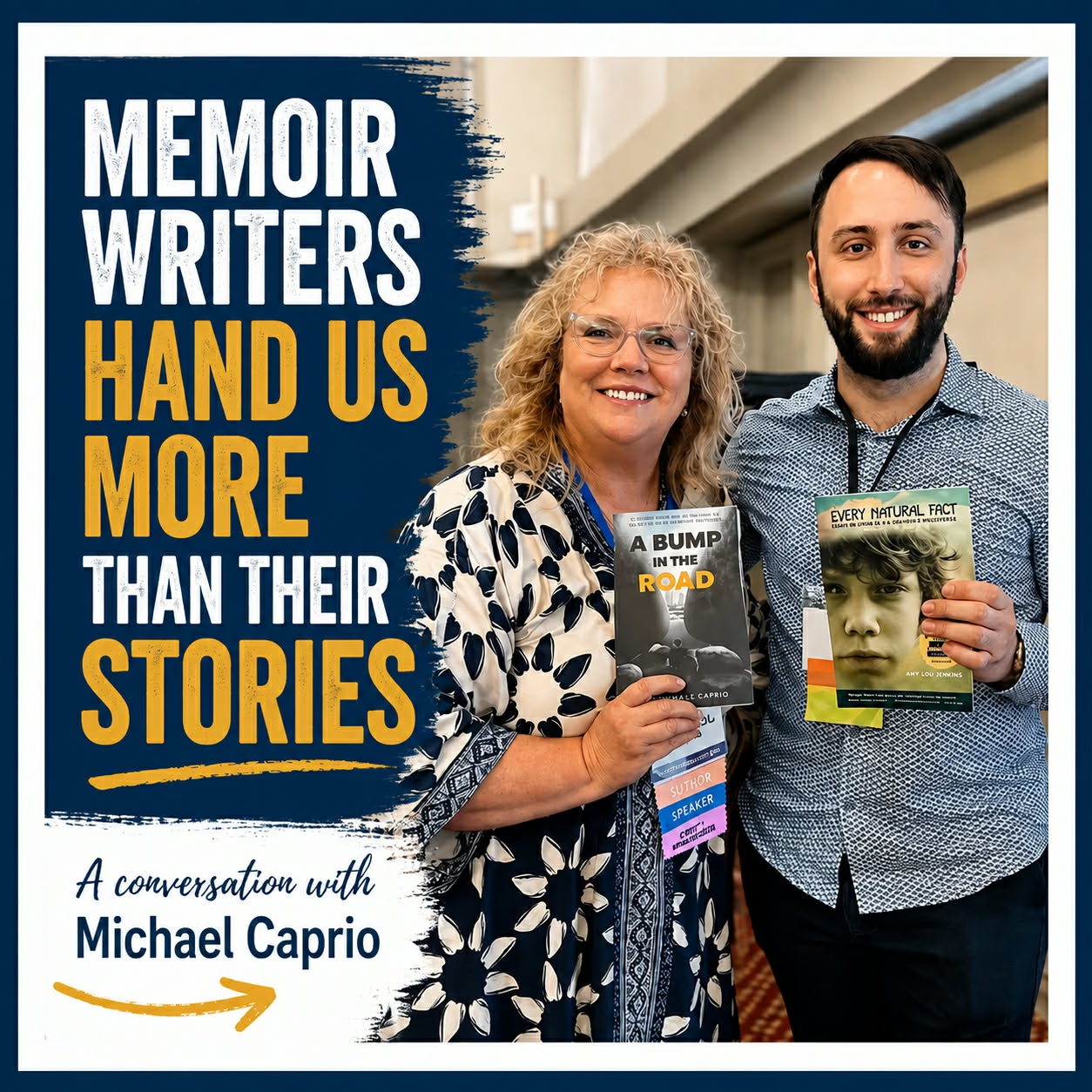
By Amy Lou Jenkins, BSN, MFA — author of the award-winning Every Natural Fact
At eighteen, Michael Caprio spent eleven days in a hospital bed recovering from a nine-hour surgery that removed his large intestine.
The diagnosis was Familial Adenomatous Polyposis — FAP — an inherited condition that seeds the colon with polyps by the hundreds. Left untreated, it carries close to a 100 percent lifetime risk of colorectal cancer, and it moves fast.
That could have been the story: a frightening diagnosis, major surgery, recovery, survival.
It wasn't.
A medical memoir works when the diagnosis is the beginning of the material and not the whole of it, when the writer gives equal page space to what illness did to the people around them, and when the writer is willing to put their least flattering self on the page.
A Bump in the Road: My Medical Journey over Potholes, Detours and the Bridge to Gratitude is what happened to Caprio after illness rearranged the life he expected to have. He went quiet on his family. He resented friends whose lives kept moving when his had stopped. Then he wrote about it — the surgery, and everything he did to the people who loved him while he was recovering from it.
That's a different set of questions than the diagnosis raises on its own: How do you write illness without making the diagnosis the whole story? What happens when the people who love you become part of the cost of your suffering? How much of your least flattering self belongs on the page? And what if writing your memoir changes your understanding of the person you were?
I met Caprio at the BookThinkers Conference, a gathering dominated by business and self-improvement books rather than the literary conversations I usually inhabit. Yet we ended up talking about memoir — about what happens when a private life becomes a story offered to strangers. Six moments from that conversation follow.
1. When does a medical experience become a story?
Survival gave Caprio the events. Distance — and his grandmother's example — helped him understand why they mattered.
Caprio's decision to write did not come in the hospital. It came after recovery, when he learned more about his grandmother's advocacy and the medical trial and error her generation endured. Her efforts had helped make his own path easier. What happened to him is one story. What he understands now because of it is another.
Amy Lou: At what point did you know this experience needed to become a book? What did you come to understand that you had not understood while you were living through it?
Michael: For me, it was after I had made a full recovery and learned about my grandma's advocacy efforts during her life. When I fully understood how much trial and error was done in her life all for the sake of advancing research on potentially finding a cure one day, it became apparent that this was something I needed to do. Especially since I had already been considering it on my own, learning of her efforts is what put my desire over the top. The work she did is part of the reason my road to recovery was easier in comparison to hers. When I was living through my surgeries and the subsequent recoveries afterward, I was in survival mode. I couldn't process my situation in totality and it was only after the survival phase of my recovery was over, that I was able to even think about the next steps that I took, such as writing the book.
The event isn't the story. The event gives you material, not a story. Caprio found his by looking past himself, to his grandmother, and the trial and error her generation absorbed so his path could be shorter. Before you ask am I ready to write this, ask what you can see now that you couldn't see while you were living it.
2. What can reading great memoirs teach you about your own?
Before writing A Bump in the Road, Caprio studied a shelf that had almost nothing in common with him — a Navy SEAL's memoir, a movie star's, an NFL kicker's, a former Guantánamo detainee's. What he found in common wasn't structure or style. It was disclosure.
Amy Lou: Which memoirs or illness narratives helped you find the shape of A Bump in the Road? Were there writers who influenced how you handled voice, structure, humor, disclosure, or the passage of time?
Michael: Can't Hurt Me by David Goggins, Greenlights by Matthew McConaughey, Alive & Kicking by Rolf Benirschke, The Mauritanian by Mohamedou Ould Slahi. Not really. The influence these memoirs had on me wasn't my writing style but more so I wanted to know what made a great memoir, great. All of those memoirs are highly regarded and sold millions of copies, since I wanted to write a great memoir I read a bunch of great memoirs. What I learned from doing that is a great memoir is extremely vulnerable and honest regarding the unexpressed emotions that we keep to ourselves. The more personal and raw a story was the deeper it resonated with the reader. This is why in my memoir I let all my scars show so to speak and let the reader in on all the thoughts going through my mind, including the darkest.
Read for trust, not technique. That's the real reading assignment — not how a writer built a scene, but why you believed them enough to keep reading.
3. Who needs the story you're reluctant to tell?
Thinking about his reader changed what Caprio was willing to reveal.
Caprio names people with FAP as an important audience for his book, but he doesn't stop there. He wrote for people enduring difficult periods that others may know little or nothing about. That imagined reader affected what he left on the page.
Amy Lou: Who did you write this book for? How did that reader affect what you chose to reveal, what you held back, and how you told the most difficult parts of the story?
Michael: I wrote this book for anybody going through a difficult time in life, especially FAP patients but not limited to them. So often in life we don't know about the struggles people go through behind closed doors until it is too late. These conversations never happen because they are hidden behind shame, guilt and appearances that they are trying to keep up. By being totally transparent and open about all the things that happened to me, I hope it has started conversations in other people's lives that were going unsaid. Ultimately I decided when writing my memoir, especially after reading the memoirs I mentioned in the previous question, that the only way I could write this story was if I reveal everything, even the parts that I wasn't comfortable with at first. The reason I knew I needed to share those parts is because I kept the reader in mind, knowing that someone has probably gone through what I was debating on leaving unwritten, and if I left it unwritten they would be disappointed.
"Who's my reader" is an editing question, too. When you're tempted to cut a difficult passage, ask whether you're cutting it because the reader doesn't need it, or because you don't want the reader to know it. Those aren't the same reason.
4. What belongs on the page when the truth makes you look bad?
Illness makes a patient sympathetic almost by default. Caprio wasn't interested in the free pass. His chapter "Rock Bottom" holds the memories he's still ashamed of, and he put them on the page anyway.
Amy Lou: What advice would you give another writer deciding what to disclose from a hard chapter of their life? How do you turn that moment into a scene the reader can feel, instead of a report of what happened to you?
Michael: If you want your story to really have the impact you desire, you have to go all in with being transparent. That includes the moments you don't want to share or hesitate to share at first. We all have parts of ourselves that we aren't the most proud of and there are aspects of our lives we all wish we could forget to one degree or another. When you choose to share that moment, a reader out there will feel less alone in this world knowing that someone else went through a similar dark experience as them and came out on the other side of it ok. Choosing to leave that moment out of your story is selfish in a way and robs the full potential of your story. To make the scene feel real, you have to include the real raw thoughts you possessed in the moment. Not just the rundown of actual events but how those events were making you feel in the moment. For me, with my own story, the best example I can give is my Chapter called Rock Bottom. I detail in full, my Rock Bottom moment that made me snap out of it. The details in this chapter were the hardest to write on paper since a lot of the memories hold a great deal of shame for me. But they are necessary details in my story, so I included them, including my shameful thought process at the time. This chapter I have heard from readers over the years, is their favorite because of the rawness of it.
Write toward the scene you want to sanitize. Caprio calls withholding it selfish — another writer might draw that line elsewhere; privacy and other people's safety are real limits. But his test is sharper than a rule: notice which scene you most want to clean up, and ask why. "I was angry" is a report. The thought you're ashamed you had is what puts the reader inside the anger.
5. What if gratitude doesn't arrive when the crisis ends?
A Bump in the Road promises a "Bridge to Gratitude" in its subtitle. Getting there took longer than the subtitle suggests. Caprio went quiet on his family, then watched what that silence was doing to them, and started acting differently before he felt differently.
Amy Lou: How do you practice gratitude while you're still suffering, still in survival mode, before any distance or recovery? And how did you hope to move your reader toward doing the same?
Michael: As I wrote in my book, for me it started with faking it until I started to make it. It was still incredibly difficult for me to accept responsibility for my situation and to take care of myself but after I realized the hurt I was putting my family through, I put my own feelings to the side for a while. Perhaps at the time I wasn't conscious of it but I was putting on a strong face and going forward to ease the stress from my family's minds. Knowing that by accepting responsibility for my health and trying to be more engaged with them, as opposed to prior when I was going mute on them, was helping them was enough for me to get started at first. Then as time went on, I started to gain things back in my life and before I knew it I wasn't faking it anymore. It was important for me to highlight to the reader that I didn't have all the answers at first and that it took a while before true happiness came back. It wasn't and never is a switch you can just flip. It took time but you have to have motivation to want to get towards being better... for me that was being strong for my family. That simple, small step was enough to get the ball rolling towards a life that I am very grateful for today.
Let the messy timeline stay messy. Caprio didn't flip a switch; he acted better before he felt better, and the feeling caught up later. That's less satisfying than a clean turning point, and more believable — a reader trusts the path more when it isn't straightened out after the fact.
6. What did writing reveal that illness couldn't?
I understand my own life better once I've written it down. Writing my forthcoming memoir, The Alchemy of Sass, showed me ways I'd been judging myself that I hadn't recognized until the page put them in front of me. So I asked Michael what the page showed him. His answer wasn't that he discovered his courage. He discovered his selfishness — that he'd wanted his peers to stop their lives because his had stopped, and resented anyone who couldn't understand a thing he didn't fully understand himself.
Amy Lou: I understand my own life better once I've written it down. While writing The Alchemy of Sass, I uncovered ways I'd been judging myself that I hadn't noticed were there until the page showed them to me. Did writing A Bump in the Road show you a belief or a blind spot about yourself, something you hadn't seen clearly until you had to put it into words? What did you learn from writing the book? (Name one to three things.)
Michael: Writing my story definitely highlighted a lot of my blindspots and worse tendencies over the years and was able to make me more conscious of it in a way I wasn't before. The biggest one was realizing my selfish nature during the years of my surgery and recovery. I wanted my peers to stop what they were doing and stand still with me as my life came crashing down. I held grudges against people who couldn't have understood what I was going through because I myself didn't even fully understand what I was going through. I was a broken person who wanted someone to fix me. To put me back together and tell me it was going to be ok. Anyone who didn't give me that undivided attention, I thought was a bad person and treated them as such. It is a horrible way to live as it erodes your soul over time but it also affects your ability to form relationships. Everyone is going through their own battles behind closed doors and the last thing anyone needed from me at that time was to inherit all of my baggage. I had to sort through it before I placed that burden on someone else. Which is a lesson I have luckily learned from.
The difficul question in memoir go beyond what happened or how did it change me. We don't just change what we think about our lives we change how we navigate our lives and understanding. And quite often the world becomes more grey.
A medical memoir is about more than what happened to the body
Michael Caprio's story begins with FAP and the removal of his large intestine. But A Bump in the Road doesn't end where his physical recovery does.
Illness altered the way he related to his family. It changed what he expected from his friends. Gratitude arrived gradually, in behavior before feeling. And writing forced him to confront a version of himself he could see clearly only in retrospect.
That suggests a useful distinction for anyone writing a medical memoir:
The diagnosis tells us what happened to your body. The memoir asks what happened to your life.
And the strongest medical memoir may push one question further:
What can you see about that life now that you couldn't — or wouldn't — see then?
For Caprio, answering that meant letting readers see more than his scars.
It meant letting them see him.
Amy Lou Jenkins holds a BSN from Alverno College and an MFA in Literature and Creative Writing from Bennington College. She is the award-winning author of Every Natural Fact: Five Seasons of Open-Air Parenting (winner of the Ellis/Henderson Award for Outdoor Writing), Friends, and Corners, with a new memoir, The Alchemy of Sass, forthcoming. She teaches narrative nonfiction writing at colleges and universities, in workshops, online, and at WriterClubhouse.com.